
Food Preparation and Nutrition
Why study Food Preparation and Nutrition?
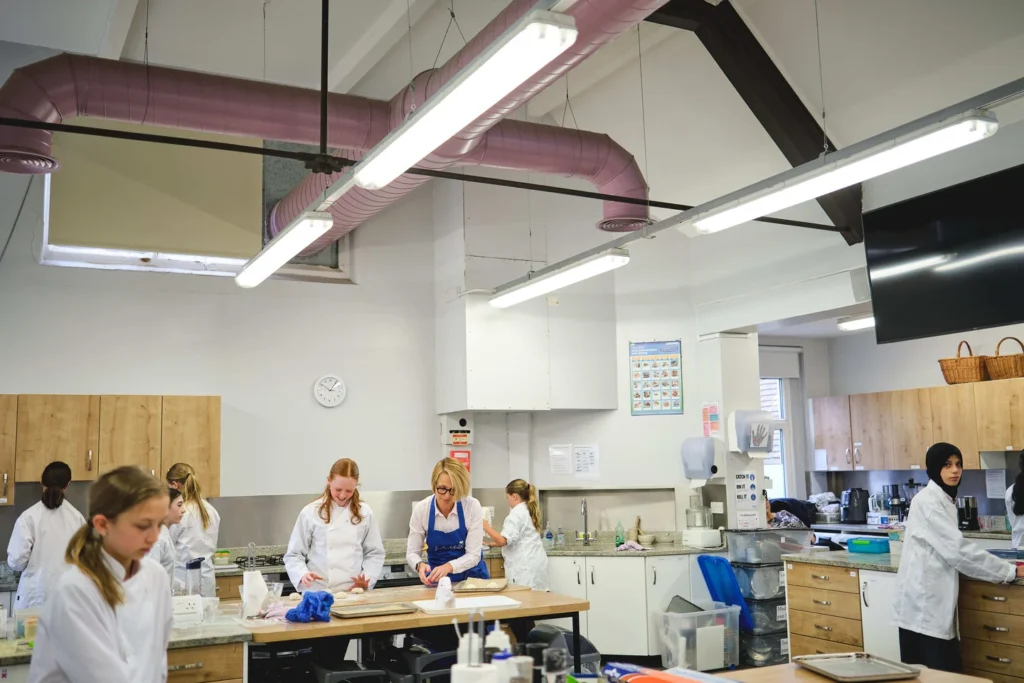
Food Preparation and Nutrition is an engaging course with elements that will allow all learners to reach their full potential, and the combination of both practical and theoretical lessons appeals to many. Pupils have their lessons in a dedicated theory classroom and state-of-the-art kitchen, both of which are excellently equipped, and allow teachers to bring the subject to life.
The diverse range of lessons can range from debating the use of additives in food products, designing nutritional plans for different people, conducting sensory tests on a variety of food products and investigating the science behind the food we eat.
The non-examined assessment (NEA) usually appeals to pupils who enjoy producing work over a period of time and like to show off their creative flair. The examined components provide the opportunity for pupils to demonstrate their theoretical knowledge. Organisational skills are important for success, as pupils must bring their ingredients to each required practical lesson.
What does the course involve?
The subject content, which is mostly studied in Year 10, focuses on five key topic areas:
- Human nutrition.
- Food science.
- Food provenance and food choice.
- Cooking and food preparation.
- Food safety and hygiene.
Regular practical lessons ensure that pupils have excellent cookery skills, which they require for their NEA. Year 11 focuses mainly on NEA (outlined below) and revision of key topics for the final exam.
How is the course assessed?
1 hour 30 minutes written examination paper, covering theoretical topics relating to food, with a focus on nutrition. 50% of total GCSE.
NEA1: Food Investigation Task
This is a food science investigation that examines the function of ingredients. Through practical experimentation, you will investigate and evaluate an understanding of the working characteristics, functional and chemical properties of ingredients. 15% of total GCSE.
NEA2: Food Preparation Task
You are required to prepare, cook and present three dishes within three hours. There is time to thoroughly and accurately plan, in advance, how this will be achieved. Written evidence of how you have planned, executed and evaluated the preparation, cooking and presentation of the three dishes within a three-hour period should be submitted along with photographic evidence to demonstrate the students’ application of technical skills and the quality of their final dishes. 35% of the total GCSE.
What can a GCSE in Food Preparation and Nutrition lead to?
This subject can lead on to both artistic and scientific careers, as it has both creative and analytical aspects, and therefore can lead on to a broad range of A Level subjects. It would be very beneficial for anyone wanting to study the Level 3 Alternative Academic Qualification in Food Science and Nutrition, a food-based degree, or a career in food science or hospitality a growing industry, with varied sectors.
What skills does the Food Preparation and Nutrition course develop?
Food Preparation and Nutrition encompasses aspects from many other subjects, including writing skills when answering exam questions, mathematical and analytic skills when conducting nutritional analyses, ICT skills to produce controlled assessment, and scientific skills when designing and conducting food science experiments. Pupils will also get to showcase their artistic and creative flair when presenting their dishes.
Pupils will leave the course as creative problem-solvers and confident learners that have acquired the skills that will allow them to cook well and maintain good health throughout life, a valuable asset to all.
At a Glance
Exam Board
OCR
Assessment
50% written examination
- 15% NEA 1
- 35% NEA 2
Head of Department
Mrs L Archibald
Related Subjects
-
Biology
View subject →: BiologyWhy study Biology?
There has never been a more important time to gain a fundamental understanding of Biology. Studying Biology … -

Chemistry
View subject →: ChemistryWhy study Chemistry?
The Chemistry course is engaging, innovative and relevant to everyday life. Learning about Chemistry will help you … -

Computer Science
View subject →: Computer ScienceWhy study Computer Science?
We live in a world where technology is evolving at an unprecedented rate, influencing developments in …