Physics
Why study Physics?
Physics helps us to understand the world at every scale — from the structure of distant galaxies to the behaviour of the particles that make up matter itself. It is one of the most exciting and relevant subjects for the modern world, underpinning advances in areas such as artificial intelligence, medical imaging, renewable energy, climate science, quantum computing, and space exploration.
For academically ambitious students, Physics offers the opportunity to think deeply, question confidently, and solve complex problems creatively. It develops intellectual resilience and curiosity, encouraging students to challenge assumptions and explore how scientific ideas shape the future of our society.
Entry requirements
You will need to achieve a Grade 8 or above in GCSE Physics and a Grade 7 or above in Mathematics. More importantly, we are looking for students with an enquiring mind, who enjoy asking questions about how and why things happen. You should be enthusiastic to engage fully in both theoretical and practical work.
It is not essential to study A Level Mathematics alongside Physics. However, Physics students who also study A Level Mathematics may find that this complements their learning in Physics by providing further opportunities to develop and reinforce shared key skills and supporting confidence with more advanced problem-solving.
Course content
The course is structured into a series of interconnected topics across the two-year programme, allowing students to build a deep and coherent understanding of Physics.
In Year 1, students build a strong foundation of the core ideas of Physics, beginning with particles and the fascinating world of quantum phenomena alongside progressing their GCSE knowledge of electricity. Students develop this further through the study of waves, forces and motion, and materials, gradually constructing the conceptual and mathematical framework needed for more advanced study in Year 13.
In Year 2, students progress to more sophisticated and wide-ranging areas, including gravitational, electric and magnetic fields, simple harmonic motion, capacitance, electromagnetic induction, nuclear physics, and thermal physics.
All students at LHS study the Option D module ‘Turning Points in Physics’, which brings the subject to life through the pivotal discoveries that have reshaped our understanding of the universe and the scientists behind them.
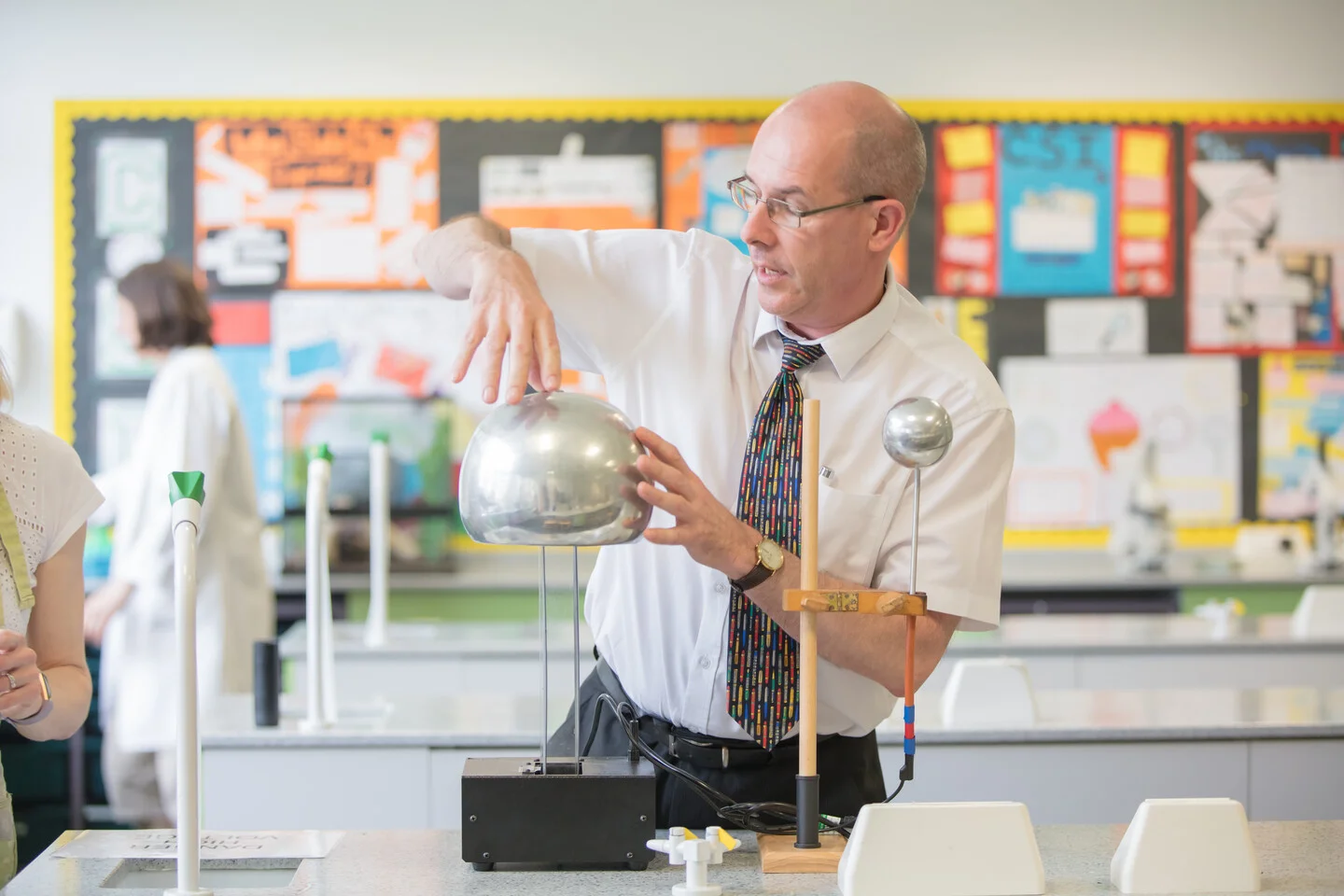
Throughout the course, students are encouraged to think and work like physicists, developing the practical skills needed to underpin theoretical learning. They develop confidence in conducting practical investigations, interpreting data, and tackling unfamiliar problems with increasing independence and sophistication, building the experimental and analytical skills essential for success in Physics at A level and beyond.
Relevance
An A Level in Physics is highly valued for its academic rigour and its relevance to the modern world. It develops strong analytical problem-solving and mathematical reasoning skills, alongside the ability to interpret and apply complex information logically.
Physics prepares students to understand and engage with the technologies shaping today’s world from energy and healthcare to communications and emerging technologies. It equips them to approach future global challenges with confidence and insight.
Career versatility
Physics is a strong foundation for a wide range of university courses and future pathways. It is highly valued by universities and employers for the intellectual challenge it develops.
Students may go on to use Physics in areas such as engineering, medicine, finance, data science, environmental science, and scientific research, alongside many other fields both within and beyond STEM.
At its core, Physics trains students to think logically, model situations mathematically, and approach unfamiliar problems with confidence. It is an excellent choice for those who want to keep their options open, while building a strong academic platform for future study and employment.
Academic flexibility and skills developed:
Physics develops the habits of mind needed to tackle complex and unfamiliar challenges with confidence. Students learn to break problems down systematically, apply mathematical reasoning, and draw clear conclusions from data and evidence.
Alongside this, they build independence, resilience, organisation, precision, and effective communication, both in written explanations and practical work.
These strengths are developed throughout the course and underpin success in a wide range of academic subjects and future pathways, making Physics one of the most versatile A Level choices available.
“I chose Physics at A Level because I found the GCSE interesting but wanted to know more. The course is varied, and the teachers are passionate and organised. Physics lessons are like a breath of fresh air. It’s fairly balanced in content, so it’s a great choice regardless of whether you prefer the practical or theoretical side of the course.”
Sixth Form student
At a Glance
Exam Board
AQA
Assessment
The course is assessed through three final 2-hour exam papers.
Papers 1 and 2 each account for 34% of the total marks and cover the core topics. Paper 3 is 32% and covers the assessment of practical and analytical skills, as well as the content of the option topic studied.
Entry Requirements
Grade 8 in GCSE Physics
Grade 7 in GCSE Mathematics
Head of Department
Dr S Wilson
Leads To
Computing, Engineering, Renewable Energy and Climate Solutions, Medical Physics and Healthcare Technology, Space Science
Related Subjects
-
Biology
View subject →: BiologyWhy study Biology?
Biology is a constantly evolving subject that is more relevant than ever before. The A Level course … -
Chemistry
View subject →: ChemistryWhy study Chemistry?
A Level Chemistry offers the opportunity to explore the principles of Physical, Organic, and Inorganic Chemistry in greater … -
Computer Science
View subject →: Computer ScienceWhy study Computer Science?
Computer Science is one of the most exciting and important subjects in today’s world. At its …